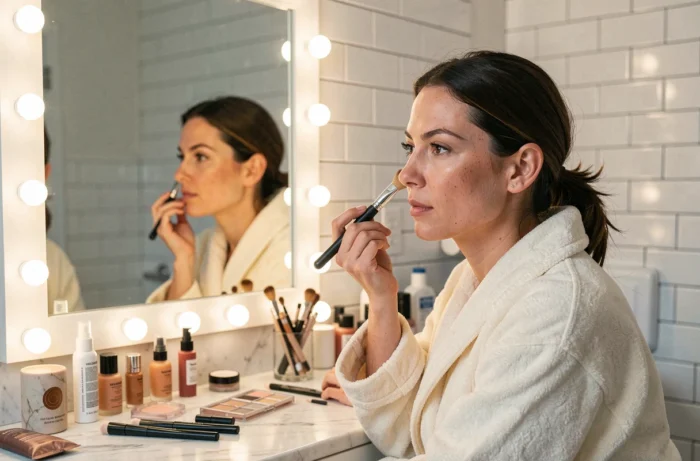
Foundation should not be chosen under the artificial light of a store. The color temperature of neon lights skews the undertone towards yellow or pink, which systematically distorts the match with the skin tone. For perfect makeup, the test should be done in natural light, on the jawline, never on the back of the hand.
Undertone and Foundation Oxidation: The Often Misplaced Technical Basis
A foundation oxidizes upon contact with sebum and air. The shade darkens by one to two tones in the hours following application, depending on the formulation and skin type. Ignoring this phenomenon means selecting a shade that is too dark by the end of the day or too light at application.
To anticipate oxidation, we recommend testing the shade in the morning and then checking the result four hours later. Oily skin accelerates the process, while dry skin slows it down. A mattifying primer reduces the speed of oxidation by limiting excess sebum on the surface.
Undertone (warm, cool, or neutral) takes precedence over clarity when choosing a base. A foundation with the right clarity but the wrong undertone gives an immediate mask effect. Three reliable indicators: the color of the veins on the wrist (blue-purple for a cool undertone, green for a warm undertone), the reaction to gold versus silver jewelry, and the natural color of the lips without product.
Specialized resources, such as those available on clairemakeupandco.fr, detail these criteria to guide the diagnosis before any purchase.
Long-Lasting Makeup: Formulations and Regulatory Restrictions to Know
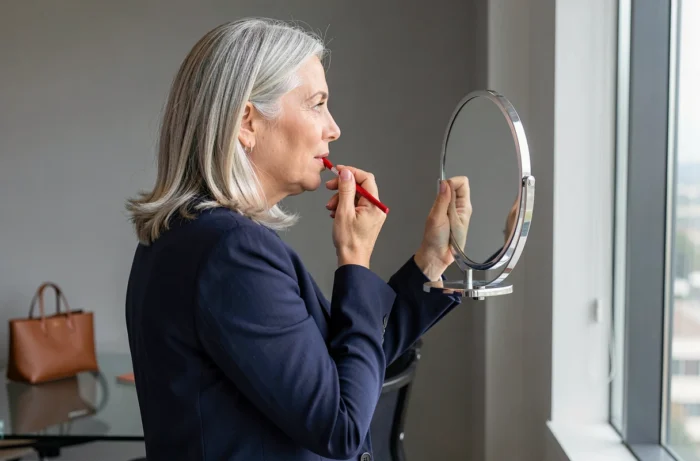
The longevity of makeup for several hours primarily depends on the layering strategy: primer, foundation, setting powder, setting spray. Each layer has a specific function.
- The primer fills in pores and creates a surface for the foundation to adhere to. A silicone primer smooths the texture, while a hydrating primer is better suited for dehydrated skin.
- The translucent loose powder absorbs sebum without adding coverage. It is pressed onto the T-zone (forehead, nose, chin) with a brush or puff without being spread.
- The setting spray seals everything in. Alcohol-based formulas dry quickly but can be drying on sensitive skin. Alcohol-free formulas offer a more comfortable finish.
Waterproof products, often recommended for long events or outdoor use, rely on film-forming polymers. European regulations are evolving on this point: a restriction concerning PFHxA and related substances will apply to cosmetics placed on the market from October 10, 2026, under EU Regulation 2024/2462. Some long-lasting formulations will need to be reformulated, which could change the texture and durability of several current waterproof products.
For makeup intended for a wedding or a full day outdoors, the combination of silicone primer, long-lasting foundation, and setting spray remains the most reliable sequence.
Eye Makeup and Allergy Risks: What Classic Guides Omit
An allergic reaction on the eyelids does not always come from the product applied to the eyes. Allergens can be transferred by hands, for example, from nail polish handled just before applying eyeshadow. This mechanism of indirect transfer is documented in dermatology but rarely mentioned in makeup guides.
In case of recurring redness, itching, or swelling, a dermatologist can perform patch tests with the patient’s personal products. This approach identifies the specific allergen, which avoids eliminating products that are not responsible through trial and error.
The label “hypoallergenic” on a package offers no universal guarantee. This term has no binding regulatory definition: it indicates that the manufacturer has reduced the number of common allergens, not that they have eliminated them all. A person sensitized to nickel, rosin, or certain preservatives may react to a product labeled hypoallergenic.
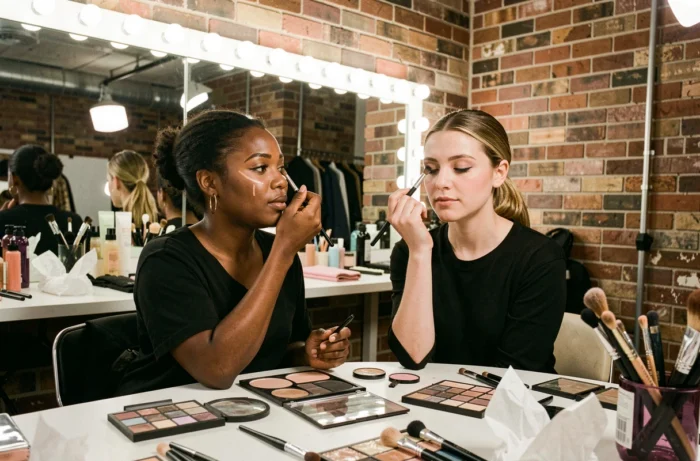
For sensitive eye makeup, formulations that are fragrance-free, preservative-free from the isothiazolinone family, and tested under ophthalmological control provide a more reliable foundation than simple marketing claims.
Adapting Makeup to the Occasion: Three Quick Transition Techniques
Transitioning from a daytime look to an evening look does not require starting over. Three targeted adjustments are sufficient.
The first concerns the eyes. A smudged kohl pencil line on the lower lash line, combined with an additional layer of dark eyeshadow in the crease, intensifies the gaze without reapplying the base. Building intensity with thin layers avoids a caked effect.
The second focuses on the lips. Replacing a tinted balm or gloss with a matte lipstick immediately restructures the face. A lip liner applied before the lipstick prevents pigment migration, especially on liquid matte formulas that tend to feather into fine lines.
The third lever is glow. A highlighter applied to the cheekbones, the bridge of the nose, and the Cupid’s bow captures artificial light in evening environments. Cream textures blend better on foundation that has already been in place for several hours, where a powder may emphasize dry areas.
- Day to evening: intensify the eyes, structure the lips, add glow.
- Office to dinner: often a single gesture is enough, switching to a bolder lip shade.
- Ceremony to reception: touch up the powder on the T-zone, revive the blush, retouch the mascara on the outer lashes.
The perfect makeup does not exist in a fixed version: it adjusts to light, duration of exposure, and the energy of the event. A minimal touch-up kit (compact powder, lip pencil, travel-sized highlighter) covers most transitions without overloading a bag.