A wedding slideshow is often put together at the end of the evening, when the photos have been sorted and the right piece of music still needs to be found. The instinct is to play the couple’s favorite song. The problem arises afterward: the music doesn’t match the rhythm of the images, or the video ends up silent once uploaded online because the platform has detected a protected title.
Choosing the music for a wedding slideshow requires balancing three constraints at once: emotion, tempo, and usage rights.
Music Rights and Wedding Slideshow: What Blocks Sharing
We start here because this is the point that most couples discover too late. Buying a track on a streaming platform or legally downloading it does not grant the right to include it in a video shared online. The audiovisual use of a commercial song may require separate permissions for the work and for the recording.
In practice, even an unlisted video on YouTube can be detected by music recognition systems. Rights holders can then impose restrictions: forced monetization, blocking in certain countries, or complete sound removal. You end up with a silent slideshow shared with family, with no recourse.
The most reliable workaround is to prepare two versions of the slideshow. A private version, kept on a hard drive, with the couple’s symbolic song. And a shareable online version, edited with appropriately licensed music. Some professional videographers systematically deliver these two files.
Before choosing the music for the slideshow, we check the license of the track. Not all licensed music libraries are created equal: some only cover publications on the creator’s account, while others allow projects made for a third party. The license must explicitly include the slideshow and its intended distribution method (social media, private link, in-room projection).

Align the Music with the Rhythm of the Photos, Not the Other Way Around
A wedding slideshow tells a day’s story in three to four minutes. The photos follow a natural arc: calm preparations, an emotionally charged ceremony, a relaxed cocktail, a festive evening. If you overlay a single uniform piece from start to finish, the mismatch between the image and sound creates a vague discomfort that guests feel without being able to name it.
Break the Slideshow into Emotional Sequences
Before even searching for titles, we categorize the photos into blocks. Generally, three sequences are sufficient:
- The preparations and details (dress, venue, busy hands) call for a slow tempo, instrumental or acoustic, that allows the eye to rest.
- The ceremony and exchanged glances support a piece with a gradual build-up, where the voice or strings add intensity without overshadowing the emotion on the faces.
- The cocktail, dancing, and group laughter require a more upbeat transition, sometimes a sharp change of piece that reignites attention.
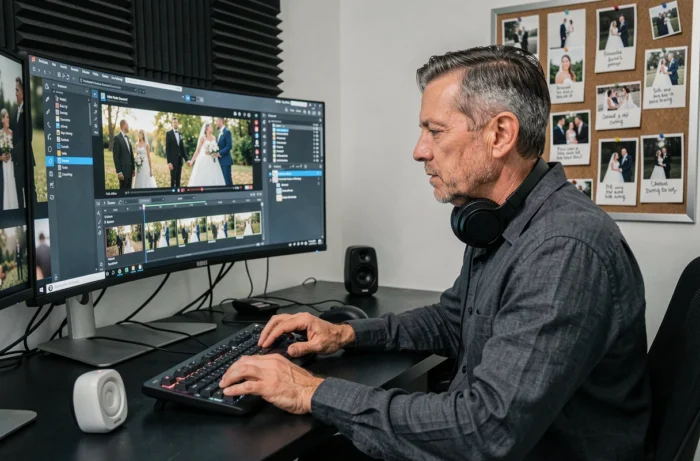
The change of music should coincide with a change of photo sequence, not in the middle of a series of portraits. In basic editing software, locate the transition point between two blocks and place the musical cut there.
Tempo and Duration of Transitions
A slow tempo piece (around 60-80 BPM) allows for long fade transitions between images. A faster piece forces short transitions, or even abrupt cuts. If you mix a fast tempo with slow fades, the slideshow gives an impression of constant delay. Therefore, we adjust the display duration of each photo to the tempo of the piece.
A simple method: listen to the piece while tapping your finger on each strong beat, then align a photo change with every other strong beat. This creates a regular visual rhythm without a video clip effect.
Choose a Musical Genre Suitable for the Couple’s Emotion
Lists of “best wedding songs” are abundant online. The problem with these compilations is that they offer the same titles to all couples, without considering what makes their story unique. An emotional slideshow relies less on the popularity of the piece than on the coherence between the music and the couple’s experience.
Start from Personal Meaning
We begin by asking a concrete question: is there a song linked to a specific moment in the relationship (first trip, marriage proposal, song heard on the day of the meeting)? If so, this song belongs in the private version of the slideshow. For the shareable version, we look for a piece in the same emotional register, with a compatible license.
If no song stands out, we start from the musical genre that the couple listens to daily. A couple that listens to acoustic folk will not resonate with a Hollywood orchestral ballad, even if it is technically “moving.” The authenticity of the choice is felt during the projection.
Instrumental or Song with Lyrics
Instrumental pieces have a technical advantage: they do not compete with any subtitles or quotes that may be embedded in the slideshow. Songs with lyrics, on the other hand, add a narrative layer, but the words must correspond to what the images show. Breakup lyrics over ceremony photos create a contradiction that attentive guests will immediately notice.
An effective compromise: a vocal piece for the central sequence (ceremony, exchange of vows) and instrumental for the preparations and the evening.
Test the Slideshow Before Projection
Never project a wedding slideshow without having watched it in its entirety at least twice, on the actual medium of distribution. What sounds good in headphones may distort in the speakers of a reception hall. The volume of the music relative to the ambient noise also changes perception: a delicate piano piece may fade away if the room is not attentive.
Checking the rendering on a phone is equally useful, since most guests will rewatch the video on a smartphone screen, with the built-in speaker. If the piece loses all its impact under these conditions, it is better to choose another one or adjust the audio levels in the edit.
The last point to check before finalizing: the total duration. A wedding slideshow benefits from staying under four minutes. Beyond that, attention wanes, regardless of the beauty of the music. Three well-edited minutes leave a stronger impression than six stretched-out minutes.