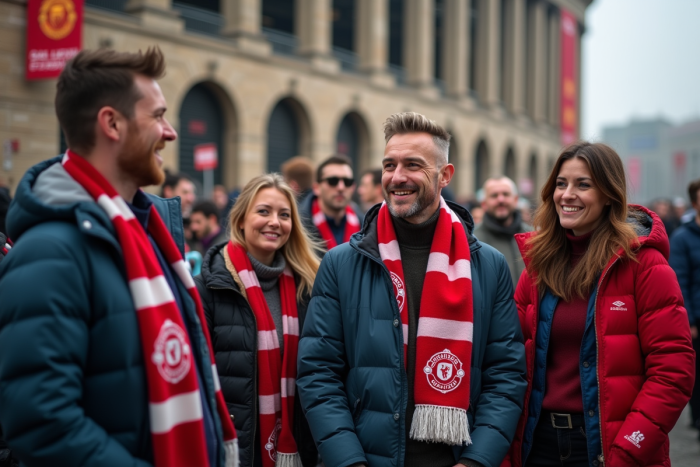
In 1984, the town hall of Lens officially recognized a supporters’ club as a stakeholder in its municipal bodies, disrupting the traditional order between elected officials and citizens. Ultra groups, long considered marginal, are now being called upon to participate in urban projects or solidarity campaigns.
This involvement goes beyond mere sports enthusiasm. The organized presence of supporters in public spaces changes the perception of belonging to the city and redistributes roles in the construction of the local collective. The boundaries between associative engagement, social claims, and football passion blur.
Supporters and clubs: a shared history that shapes the identity of cities
The relationship between supporters and football clubs stands as an invisible yet solid foundation of local identity. In Marseille, Paris, Saint-Étienne, Lens, or Rouen, it is impossible to overlook the significance of the stadium: it becomes the beating heart of a shared urban geography, marked by chants, colors, and rituals. Ultra groups and supporters’ sections structure access to the stands, control ticketing, and delineate territories where belonging is unquestioned.
Since the early 20th century, each city has seen its figures emerge: families, neighborhoods, communities. Supporters cross the threshold of the stadium, but also that of associative life. They participate in the collective memory, invite themselves into the city’s history, and invest public space. Urban identity is written in the fervor of the stands, the loyalty passed down from generation to generation, and the rivalry between clubs that sharpens attachment and adds depth to local life.
Experiences intersect: from the development of football after World War I to the social upheavals of the 1970s. Supporter culture becomes a vector of tradition and modernity. Through group dynamics, associative networks, and active participation in club life, supporters root themselves and assert their presence. Specialized forums, such as AJA 1905, bring these highlights to life: the history of supporter culture, transmission, solidarity. In these spaces, memory expands, community strengthens, and the city is told in a new light.

When the fervor of the stands becomes a mirror of local cultures
In the excitement of the stands, every gesture, every chant, every color carries much more weight than mere support. The collective fervor grows around numerous rituals:
- Respect for the dress codes of the stand
- Meticulous learning of chants
- Adherence to group rules
The supporters’ section acts as an anchor point and imposes its norms. Belonging must be earned, experienced, demonstrated.
The trip to the stadium, organized by ultra groups or distant sections, becomes a necessary passage. In the bus or minibus, bonds are formed, sociability takes shape. Loyalty is measured by the regularity of attendance, knowledge of the club’s history, and involvement in group life. The demand for recognition shapes access to legitimacy. The supporter must prove their loyalty, accept the social control of the collective, and display their attachment.
For remote supporters, the path is sometimes fraught with suspicion and stigmatization. Their place is earned over time, through gradual integration and an unwavering passion. The passion then crosses boundaries, takes root in the city, and becomes a reflection of local values and challenges. The stadium transforms fervor into an urban theater: a place of recognition, challenge, and sometimes exclusion. Because in the end, it is the whole city that vibrates, opposes, and reinvents itself under the gaze of its own supporters.