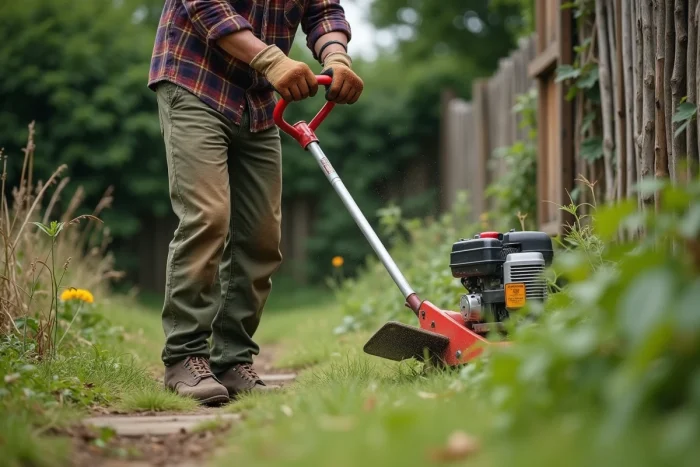
The market for thermal brush cutters is changing due to regulatory constraints that most buying guides overlook. Since 2022-2023, Phase V of the European regulation on non-road engines (NRMM) imposes stricter emission thresholds on manufacturers, gradually altering the available supply. Choosing a thermal brush cutter today also means anticipating the availability of spare parts and the model’s compliance in the medium term.
European Regulation Phase V and Thermal Brush Cutters: What Changes for Buyers
The regulation (EU) 2016/1628 and its delegated implementing regulations govern the emissions of non-road engines, which include thermal brush cutters. The gradually implemented Phase V encourages manufacturers to prioritize cleaner engines.
In practice, the most polluting old 2-stroke engines are slowly disappearing from catalogs. Brands are developing more 4-stroke models or 2-stroke models with stratified injection that meet the new thresholds. For buyers, this means that a classic 2-stroke model purchased today could face supply issues for spare parts in a few years.
Field feedback varies on this point: some specialized retailers believe that 2-stroke engines will remain available for a long time, while others already observe a tightening of ranges among several manufacturers. Before investing, checking the market launch date of the engine and its Phase V compliance is still a reflex not widely adopted by individuals.
Comparisons available on top-debroussailleuse-thermique.com allow filtering models based on their engine type and compliance with current standards, making this verification easier.
Engine Displacement and Power: Adapting the Machine to the Terrain
Engine displacement remains the primary indicator of a thermal brush cutter’s power. Models intended for homeowners generally fall within a lower range, sufficient for tall grass and light brush. Higher displacements target thick brambles, wasteland, or difficult slopes.
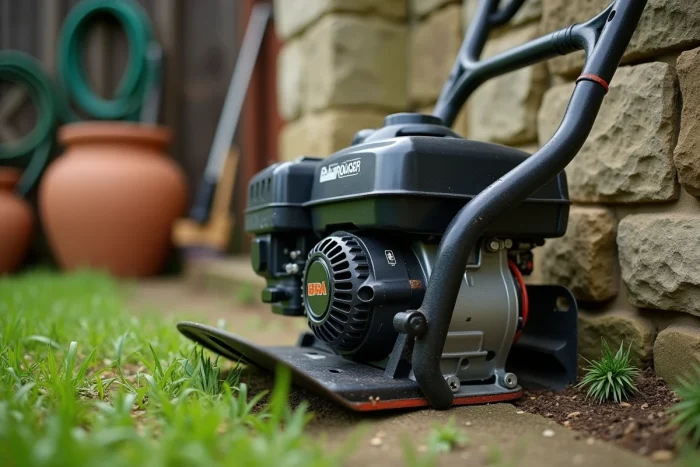
The link between displacement and user comfort is not linear. A more powerful engine implies greater weight, increased vibrations, and faster fatigue for the user. In a small garden with a few borders to maintain, a modest displacement combined with a good cutting system is more than sufficient.
- For regular maintenance of a medium-sized garden (grass, border finishing), a modest displacement with a line head covers most needs without weighing down the machine
- For occasional work on dense vegetation (brambles, young woody regrowth), an intermediate displacement associated with a disc or blade becomes necessary
- For heavy clearing on steep or rough terrain, high displacements are justified, but the machine’s weight requires a professional harness and good physical condition
The choice between a 2-stroke or 4-stroke engine also deserves consideration. The 4-stroke engine consumes less and produces fewer emissions, but it is often heavier and more expensive to purchase. The 2-stroke remains lighter and more responsive, with simplified maintenance (no separate oil sump on mixed models). The available data does not allow for a conclusion that one type of engine systematically outperforms the other for domestic use.
Cutting System: Line, Blade, or Disc Depending on Vegetation
The cutting system determines what the brush cutter can actually cut. There are three main options, each suited to a specific type of vegetation.
The line head is suitable for grass and lawn finishing. The nylon line is easily replaceable and poses no risk of dangerous projectiles when hitting a hard obstacle (stone, stump). It is the most versatile system for regular garden use.
The blade or disc comes into play when the vegetation resists the line. A toothed disc can tackle brambles and young shrubs that the line merely whips without cutting. However, a disc in contact with a stone can project shards at high speed, necessitating the use of a face shield and protective leg guards.
Some models accept both systems thanks to a compatible angle drive. This versatility criterion is often more decisive than the engine’s raw power. Checking the compatibility of cutting accessories before purchase avoids costly disappointments, as not all conical couplings accept heavy discs.
Comfort and Harness: A Factor Beginners Underestimate
The weight of a thermal brush cutter rests on the shoulders and back throughout the duration of use. During a session longer than half an hour, the quality of the harness is as important as the power of the engine.
A simple shoulder harness is sufficient for short sessions on flat terrain. For longer or sloped work, a double strap harness with a lumbar belt distributes the load and reduces fatigue. Professional models incorporate a suspension system that absorbs some of the vibrations transmitted by the machine.
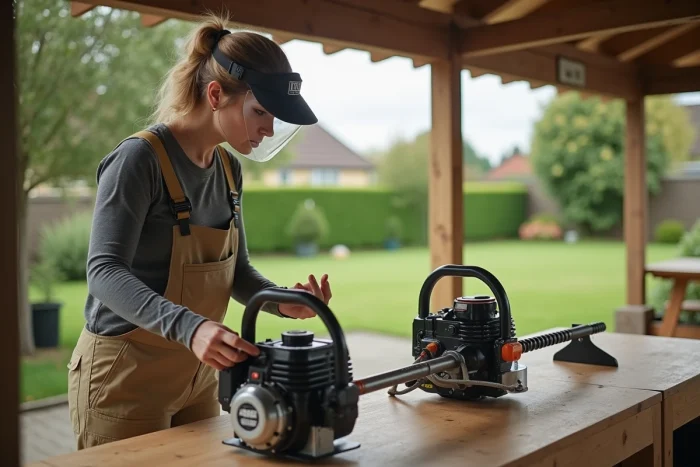
The type of handle also influences machine control. The handlebar (known as “bike”) provides good maneuverability on open terrain. The loop or D-handle allows for more precise movements in cluttered spaces, between trees or along walls.
- Simple harness: occasional use, flat terrain, sessions of less than half an hour
- Double harness with belt: regular use, varied terrain, extended sessions
- Handlebar: large open areas, wide sweeping
- Loop or D-handle: narrow areas, precision work between obstacles
Noise Restrictions in Residential Areas: A Neglected Purchase Parameter
An increasing number of French municipalities regulate the hours of use for noisy thermal tools through municipal or prefectural orders. Authorized time slots are shrinking, particularly on weekends and in the evenings. This practical constraint can significantly limit the actual usage time of a thermal brush cutter in dense areas.
In residential areas, checking the municipal order before purchasing a thermal brush cutter prevents ending up with a machine usable only a few hours per week. For gardens located in subdivisions or town centers, this restriction sometimes makes thermal investment less relevant than a battery solution, despite the latter’s lower autonomy.
The choice of a thermal brush cutter relies on a balance between engine power, cutting system, carrying comfort, and local regulatory context. A model compliant with Phase V of the European regulation, suited to the actual vegetation of the terrain, and compatible with the municipality’s time constraints remains the foundation of a sustainable purchase.