
Bringing back tobacco from Spain is a common practice for French smokers, whether during a road trip or a return flight. However, customs regulations have changed since decree n° 2024-280 of March 26, 2024, and the allowed thresholds are no longer what many travelers have in mind. The number of cartons of cigarettes you can bring back depends on European legal frameworks, as well as the assessment of the customs officers on duty.
March 2024 Decree: What Has Changed for Tobacco Brought Back from Spain
Before this decree, the indicative quantities of tobacco that an individual could transport from an EU country were set at a significantly higher level. The decree n° 2024-280 of March 26, 2024 has lowered these thresholds in France, strengthening the control and taxation powers of customs.
Spain is part of the EU. Tobacco purchased there has already been subjected to Spanish excise duties. In theory, an individual can transport tobacco from one member state to another without paying duties again, provided that the quantity remains compatible with personal use. The new indicative quantities serve as a guideline for customs officers to assess this notion of personal use.
The key point to remember: the regulation on allowed cigarette cartons from Spain has hardened the French position, and exceeding the indicative threshold does not automatically mean an offense, but triggers a thorough inspection.
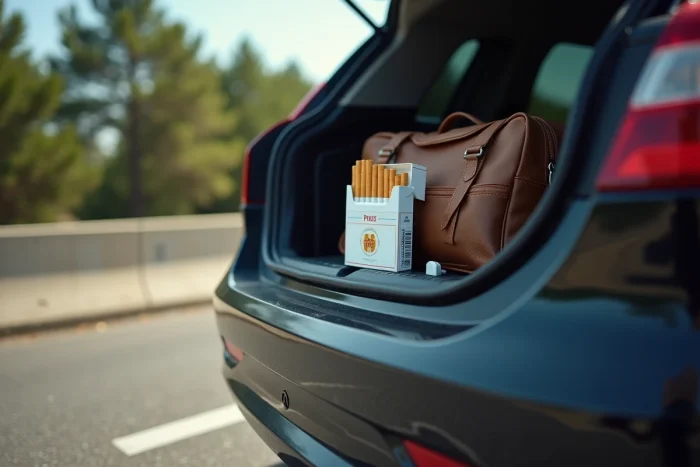
Car or Plane: The Thresholds Are the Same, But Not the Inspections
A common misconception persists: the mode of transport would alter the allowance granted. This is not the case. Whether you are returning by car through Perthus or landing at Toulouse-Blagnac, the same indicative thresholds apply.
The difference lies in the practice of inspections. French Customs reports that checks are more systematic at airports, where luggage (cabin and hold) passes through scanners. At road borders with Spain, inspections tend to be more sporadic, targeted at risk profiles.
What Customs Officers Look at Beyond Quantity
Even below the indicative quantities, officers can seize and tax tobacco if there are indications suggesting non-personal use. Several criteria come into play:
- The frequency of trips to Spain, verifiable through toll crossing data or flight histories
- The packaging of the tobacco (cartons still in cellophane in large quantities, varied brands intended for resale)
- The payment methods used during the purchase and the overall profile of the traveler (declared income, customs history)
This case-by-case assessment means that a regular traveler carrying a modest quantity may be inspected, while an occasional tourist with the same amount may pass through without issue. The frequency of round trips weighs as much as the volume transported.
Fines and Seizures: The Concrete Risk Since 2024
French Customs reports a significant increase in seizure and fine procedures for transporting tobacco from Spain since the decree came into effect. The consequences in case of exceeding limits or suspicion of resale are not limited to the confiscation of cartons.
In case of a confirmed offense, penalties can include the complete seizure of tobacco, a fine proportional to the value of the goods, and in the most serious cases (very large quantities, repeat offenses), criminal prosecution for smuggling.
A often overlooked point: seized tobacco is never returned, even if the fine is contested. A claims procedure exists, but field returns show that it rarely results in favor of the traveler.
The Special Case of Andorra
Andorra is not a member of the European Union. Travelers who detour through the principality from Spain fall under a different regime, with much more restrictive allowances than those applicable within the EU. Confusing the two regimes is one of the most common mistakes noted by customs officers at the Pyrenean border posts.

Price of Tobacco in Spain and Real Calculation of Savings
The price of tobacco in Spain remains lower than that in France, which motivates the majority of these cross-border purchases. The price difference varies by brand, but it remains significant enough to justify the trip in the eyes of many smokers.
The calculation of real savings deserves to be nuanced. The cost of travel (tolls, fuel, plane ticket) reduces the margin. For a car trip from southern France, the operation can still be profitable. From Lyon or Paris, the balance becomes tighter, especially if you adhere to the lowered indicative thresholds.
- The price of fuel and tolls between your home and the Spanish border directly reduces the savings per carton
- By plane, the ticket price absorbs a significant part of the gain, unless the tobacco is just a secondary purchase during an already planned trip
- The risk of fines and seizures, even if low, represents a potential cost that few smokers factor into their calculations
Bringing back a few cartons during a pre-planned stay remains the most sensible economic approach. Organizing a trip solely for the purpose of buying tobacco requires a good understanding of the current thresholds and staying below them, or else turning the expected savings into a net loss.
The March 2024 decree has changed the equation for cross-border smokers. The lowered thresholds, combined with reinforced inspections and a stricter seizure policy, make the margin for maneuver tighter than before. Checking the updated indicative quantities on the official French Customs website before each departure remains the only reliable precaution.