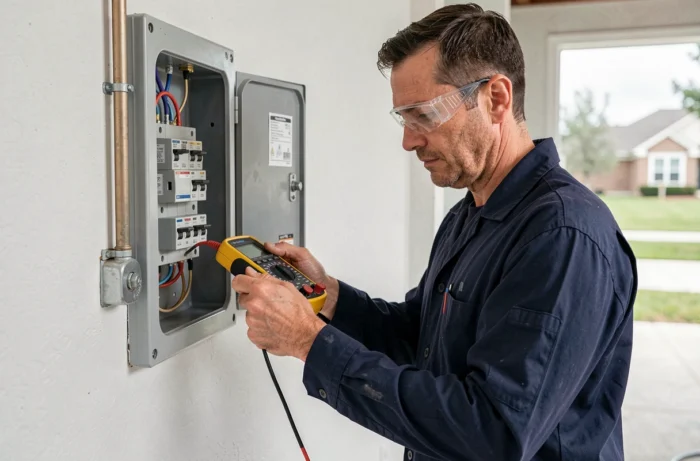
A circuit breaker that trips for no apparent reason, a socket that feels hot to the touch, an electrical panel with incomprehensible wiring: these everyday situations may seem trivial, but they often indicate a fault that goes beyond simple DIY. Entrusting your electrical work to a professional electrician is not just a matter of comfort; it is primarily about protecting people and the building.
NF C 15-100 standard series 2024: what changes for an electrical site
Most articles on the subject mention the NF C 15-100 standard without specifying that it has recently evolved. The 2024 series of this standard modifies several requirements for new low-voltage installations. A qualified professional knows how to determine which version of the standard applies to your site, which directly affects the certificate of conformity issued at the end of the work.
Have you ever noticed that two quotes for the same project can propose different cable sizes or protections? This is often related to the interpretation of the applicable standard. An electrician trained in the latest developments avoids sizing errors that would render the installation non-compliant during the Consuel inspection.
Companies like electricien-cymelec.fr work on new and renovation installations by applying up-to-date references, which guarantees the validity of the certificate provided to the project owner.
Electrical safety: the concrete risks of a poorly executed installation
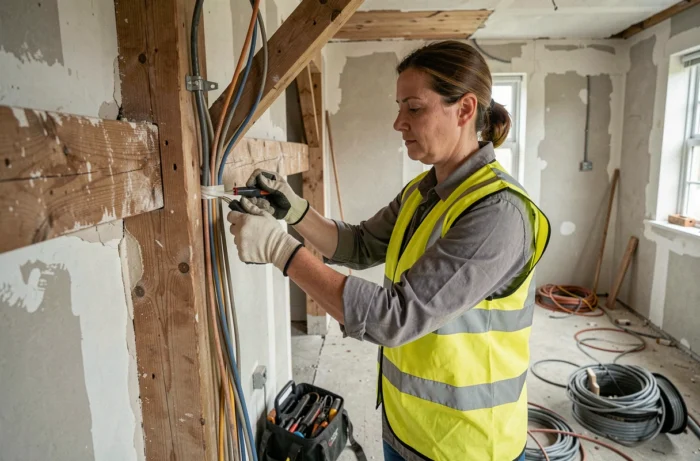
An undersized cable does not trigger a visible alert signal. It slowly heats up in the conduit, sometimes for months, before a fire starts. An invisible electrical fault can smolder for a long time before becoming dangerous.
The consequences of amateur wiring go beyond the risk of fire. Direct contact with a live conductor can cause electrocution. A poorly calibrated differential will not cut off the current in time. These are scenarios that a professional electrician anticipates from the design stage of the installation scheme.
What a professional checks before wiring
- The size of the conductors in relation to the power required on each circuit, to avoid overheating in the embedded conduits
- The rating and type of protection (circuit breaker, differential switch) suitable for each use: lighting, sockets, cooktops, water heaters
- The effective grounding of the entire installation, which remains the first barrier against electrocution
- The separation of circuits in wet rooms (bathroom, kitchen), where safety volumes impose strict rules
This verification work distinguishes a safe installation from one that merely “works” on the surface.
Charging station for electric vehicles: specific qualification required
Plugging an electric car into a standard household socket may seem sufficient. In reality, beyond 3.7 kW of power, the installation of a charging station requires IRVE qualification, in accordance with decree n° 2017-26 of January 12, 2017. This requirement goes beyond the general competence of an electrician: it requires additional certified training.
Why this threshold of 3.7 kW? Below this, the power remains comparable to that of a large household appliance. Above this, the wiring, protection, and ventilation constraints change radically. A qualified IRVE professional sizes the dedicated circuit, checks the capacity of the existing electrical panel, and installs the appropriate protections.
Obligations for company parking lots
Since January 1, 2025, certain existing non-residential buildings with more than twenty parking spaces must be equipped with charging points. The electrical pre-equipment of a parking lot goes beyond the simple installation of an isolated charging station. It requires sizing the general supply, planning dynamic power management, and protecting each charging point individually.
A professional electrician with IRVE qualification coordinates this work while considering the available power on site, which prevents overloading the existing network.
Electrical renovation of an old home: technical pitfalls
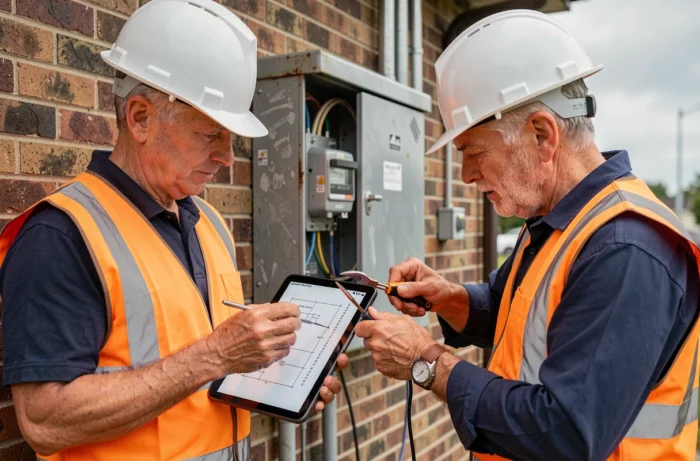
Renovating the electrical installation of an old house does not simply mean replacing sockets and switches. The original wiring sometimes uses aluminum conductors or conduits degraded by time. Renovating without prior diagnosis is like building on unknown foundations.
A professional electrician starts with a complete assessment of the existing panel and circuits. They identify the portions of wiring that can be reused and those that need to be replaced. This step avoids two common pitfalls: partial renovation that leaves dangerous circuits intact, and unnecessary total renovation that increases costs.
Home automation and modular electrical panel
Adding home automation equipment (connected roller shutters, smart thermostat, zone lighting management) requires a properly sized electrical panel. Each communicating module needs a dedicated circuit or specific connection. A professional anticipates these needs from the design phase, rather than multiplying adjustments afterward.
Getting a detailed quote from a qualified electrician allows for comparing technical solutions and their actual costs. A well-constructed quote specifies the nature of the work, the equipment references, the applicable standards, and the intervention timeline.
Hiring a professional electrician is not justified by an argument of authority. It is based on measurable technical constraints: applicable standard version, IRVE qualification for charging stations, existing wiring diagnosis in renovation. These specific points make the difference between a compliant installation and a project that needs to be redone.