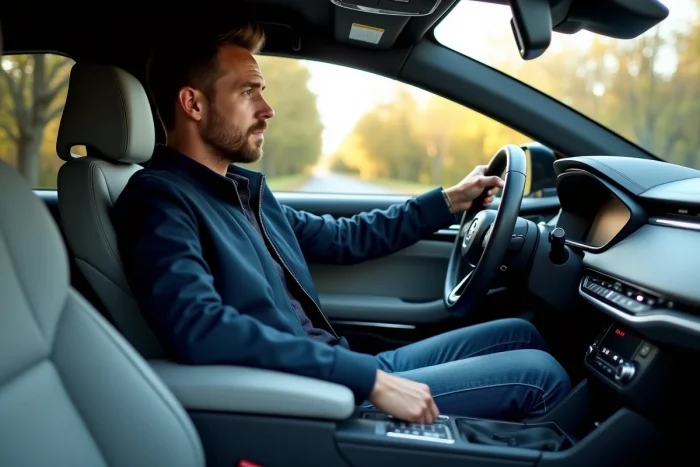
On certain Renault models equipped with an automatic gearbox, selecting mode B increases energy recovery during deceleration phases. Unlike mode D, which favors smooth driving with a more gradual deceleration, this setting enhances regenerative braking with every release of the accelerator.
This difference directly affects range and driving comfort, especially in urban environments or on hilly routes. The effectiveness of the system depends on the context of use and each driver’s expectations regarding energy management and driving pleasure.
Mode B and mode D on Renault: what are the concrete differences in daily use?
From the first kilometers behind the wheel of an electric or hybrid Renault, the distinction between mode B and mode D is immediately apparent. The mode D, which is the default on most models, offers a smooth driving experience, familiar to those coming from traditional combustion engines. The car slows down gently when you lift your foot, preserving momentum and limiting the use of engine braking. On highways or major roads, this mode promotes tranquility and linearity.
In contrast, activating mode B, the famous brake mode, changes the game. Each release of the accelerator causes a marked slowdown. Energy recovery intensifies, and the brake pedal becomes almost secondary during frequent stops. This mode excels in the city, in traffic jams, or during repeated stops. On a Twingo Electric, it sometimes allows for “one-pedal” driving over short distances, making driving more intuitive and responsive.
The differences between mode B and D go beyond mere driving impressions: they redefine the balance between comfort, consumption, and driving style. In the mountains, mode B offers valuable engine braking, ideal for controlling speed on descents, while mode D maintains comfort on flat surfaces. Depending on the terrain, traffic, and the driver’s intent, each mode reveals or fades away.
Regenerative braking: how mode B improves range and energy recovery
In an electric car, regenerative braking turns every slowdown into potential gain for the battery. As soon as you activate mode B, the dynamics change: deceleration no longer just slows the vehicle; it regenerates the battery by re-injecting energy recovered during braking. Twingo Electric, Clio E-Tech, Zoe… All benefit from this ability to capitalize on every stop or slowdown.
The specificity of the enhanced regenerative braking in mode B is especially noticeable in the city, where stops and starts are frequent. With each lift of the foot, the car slows down significantly, kinetic energy transforms into electricity, and the dashboard displays the recovered kilowatts, tangible proof of a system working behind the scenes. More daily range, less energy loss with each braking, on urban trips, the benefit is measured in additional kilometers traveled.
Here’s what mode B concretely allows in various situations:
- On descents, it preserves traditional brakes from overheating while optimizing battery recharge.
- In traffic jams, it limits the use of the brake pedal, extending its lifespan.
- Throughout the journey, it improves energy efficiency, reducing consumption and increasing range.
Mode B does not replace conventional charging, but it allows for extending daily trips through more precise energy management. For the driver, every slowdown becomes an opportunity to optimize range: a simple action, and the battery regenerates, kilometer by kilometer.

Choosing the right mode according to your journeys and optimizing your driving experience
Knowing how to juggle between mode B and mode D transforms every journey into a tailored experience. In an electric or hybrid car, this choice is not automatic: it stems from the journey profile and the type of traffic.
In the city, mode B proves invaluable as traffic thickens and stops become frequent: energy recovery skyrockets, brake wear slows down, and range extends. Less reliance on the brake pedal, more efficiency with every slowdown: ideal for daily trips punctuated by red lights and intersections.
For long distances on roads or highways, mode D makes perfect sense. It offers a flowing drive, closer to the habits of a combustion engine vehicle. Decelerations remain gradual, speed management becomes smoother and more enjoyable. Here, energy efficiency relies on anticipation and fine regulation of speed through the accelerator.
In the mountains, mode B reveals another side. It assists descents by engaging the engine brake, limiting the need for traditional brakes while recharging the battery over distance. An added safety feature, a bonus for range.
To help you choose better, here are the strengths of each mode according to the context:
- City: maximum energy recovery, preserved brakes
- Highway: optimal comfort, gentle deceleration, manual speed management
- Mountain: stability, effective engine braking, easier recharging on descents
By combining the proper use of these modes with thoughtful eco-driving, every driver can make the most of their Twingo Electric or any other hybrid model. The driving experience sharpens, consumption adjusts, and each journey becomes a demonstration of technological mastery.
Between flexibility and recovery, linear comfort or active braking, everything hinges on a simple lever. The challenge is to choose the mode that will provide the most fitting experience for each journey.